
Bifacial Solar Panels on Residential Roofs: Does It Work?
The world of renewable energy moves fast, but every now and then, a technology comes along that feels like a genuine “game changer.” If you’ve been looking into solar lately, you’ve likely heard the buzz about bifacial solar cells.
While traditional solar panels are like a one-sided conversation, bifacial panels are a full-blown dialogue with the sun. Here is everything you need to know about why these dual-sided wonders are taking over the industry.
What Exactly Is a Bifacial Solar Cell?
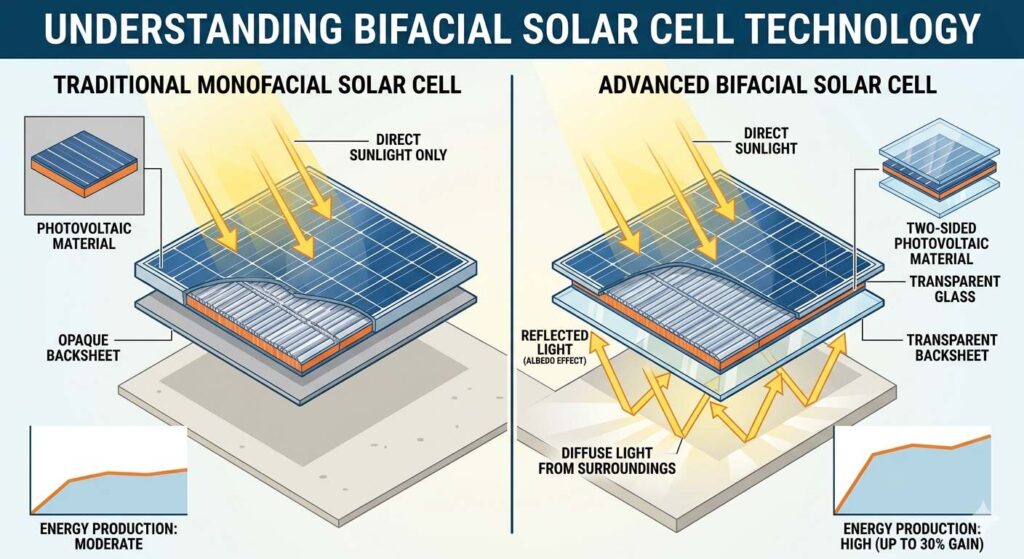
Most solar panels you see on rooftops are “monofacial.” They have a protective backing (usually white or black) that catches light on the front and ignores everything else.
Bifacial cells are different. They are designed with solar-collecting material on both the front and the back. By replacing that opaque backsheet with clear glass or specialized transparent materials, the panel can harvest:
- Direct Sunlight: Hitting the front face.
- Reflected Sunlight: Bouncing off the ground, roof, or nearby structures (known as the Albedo Effect).
- Diffuse Light: Scattered light on cloudy days that hits the back of the panel.
Why Go Two-Sided? (The Benefits)
Switching to bifacial isn’t just a trend; it’s backed by some pretty impressive math.
- Higher Efficiency: Depending on the surface underneath them, bifacial panels can produce 10% to 30% more energy than their single-sided cousins.
- Durability: Because most bifacial modules are “glass-on-glass,” they are incredibly sturdy. They handle high winds, UV degradation, and chemical stresses better than traditional panels.
- Performance in Low Light: Even when the sun isn’t directly overhead, the rear side is busy picking up “stray” light, making them more consistent throughout the day.
- Better ROI: While the upfront cost is slightly higher, the increased energy yield usually means the system pays for itself much faster.
The Secret Sauce: The Albedo Effect
The true power of a bifacial panel depends on what it’s sitting over. The “Albedo” is a measure of how much light a surface reflects.
| Surface Material | Reflectivity (Albedo) | Potential Energy Gain |
|---|---|---|
| Grass/Dirt | Low (approx. 10-20%) | Modest gain |
| Concrete/Gravel | Medium (approx. 30-40%) | Solid gain |
| White Membrane/Snow | High (approx. 70-90%) | Maximum gain |
Are They Right for Your Roof?
Before you rush out to buy them, there is a catch: Bifacial panels need space to breathe.
If you bolt a bifacial panel flush against a dark shingle roof, the back side has no light to catch. They perform best in:
- Ground Mounts: Where they sit a few feet off the grass or gravel.
- Commercial Flat Roofs: Especially those with white “cool roof” membranes.
- Carports and Awnings: Where the underside is completely exposed.
- Snowy Climates: Where the ground acts like a giant white mirror for half the year.
Conclusion
Bifacial solar cells represent the natural evolution of PV technology. We’ve spent decades trying to make the front of the panel more efficient; now, we’re finally realizing that there is a whole lot of energy hitting the back, too.
If you have the right location and a bit of height, going bifacial is one of the smartest ways to squeeze every possible drop of power out of the sun.